En
 Français
 Nederlands
 Deutsch
 Español
 Italiano
New

CPAP humidifiers add moisture to the pressurised air to put an end to nasal dryness, a sore throat on waking and general irritation. This is the accessory that takes CPAP therapy from "bearable" to "comfortable", above all in winter when the central heating dries out the bedroom air.
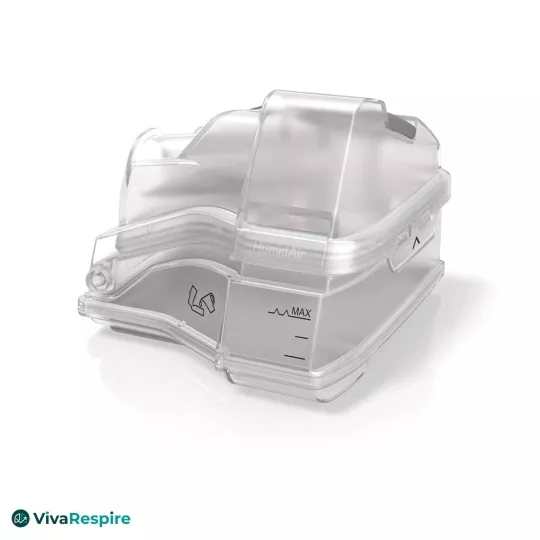
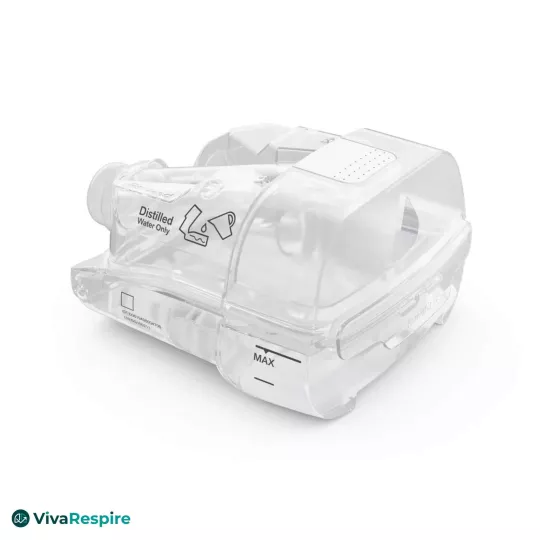
At VivaRespire you will find the ResMed HumidAir Cleanable chambers: HumidAir II Cleanable for the AirSense 10 and HumidAir 11 Cleanable for the AirSense 11.
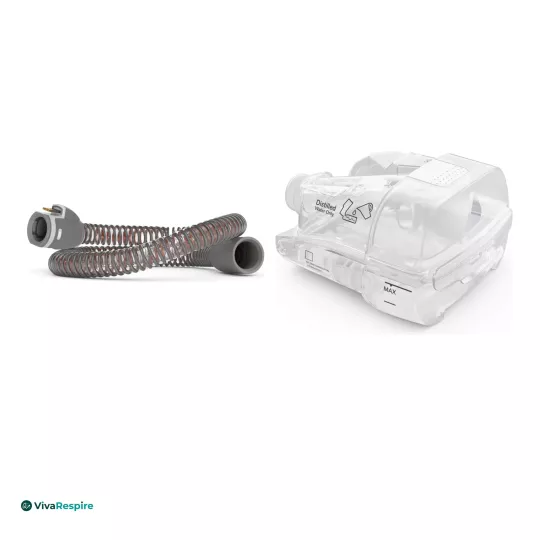
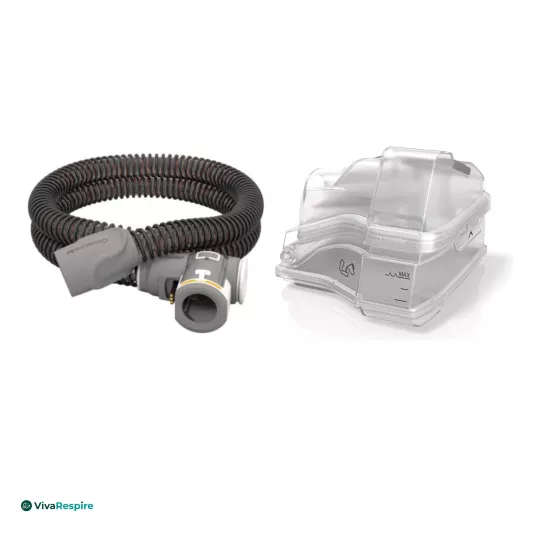
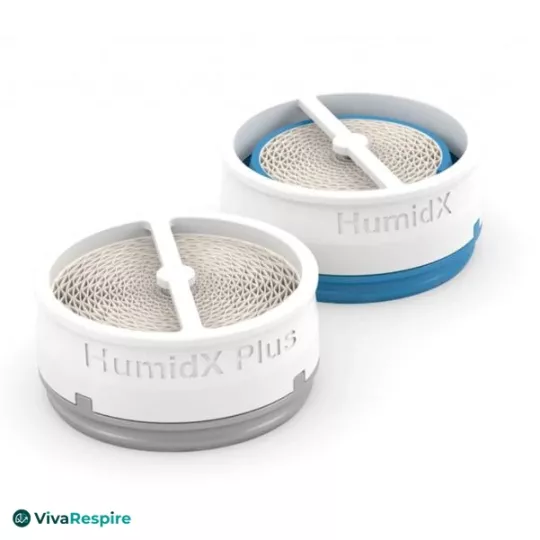
The CPAP humidifier is the accessory that changes how the treatment feels. Without it, pressurised air dries out the nasal lining and brings on dryness, a sore throat, nosebleeds and congestion on waking. With it, the therapy becomes comfortable, almost unnoticeable.
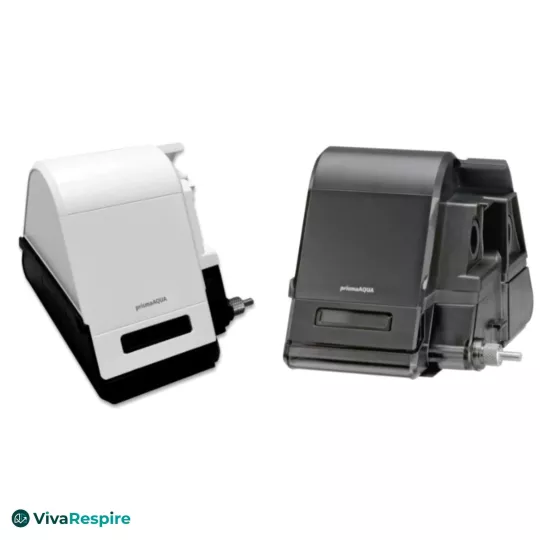
Most modern CPAP machines (ResMed AirSense 10 and 11, Philips DreamStation, Löwenstein prisma) build the humidifier into the housing or clip it on. You fill the chamber each evening, the device warms the water and humidifies the air it delivers.
Important: the HumidAir II and HumidAir 11 chambers are not interchangeable. The clip, the seal and the dimensions all differ. Check your model before ordering.
On the AirSense 10 and the AirSense 11, the humidity level runs from 1 to 8, or Auto. A practical method:
This is where people most often get it wrong, because ResMed does not give the same instruction for the two generations. Follow the one for your device:
What not to use: the non-sterile demineralised water sold for household use, which ResMed explicitly rules out on the AirSense 11. No scented water, no essential oil, no additive either: whatever you put in the chamber ends up in your lungs. Unboiled tap water leaves limescale, clouds the chamber and shortens its life.
Never use bleach, chlorine, alcohol, aromatic solutions, moisturising or antibacterial soaps, or scented oils: ResMed rules all of them out for any cleaning.
HumidAir chambers are specific to ResMed. For Philips Respironics, Löwenstein Medical, Sefam and Fisher & Paykel, specific chambers are available or being added to the VivaRespire catalogue.
Not essential, but strongly recommended. Nasal dryness, a sore throat and nosebleeds are the complaints most often reported at the start of therapy, and humidification is the direct answer to all three. In winter and in a dry climate it becomes hard to do without. Every ResMed AirSense CPAP has it built in as standard.
No. The chambers were completely redesigned between the 10 and 11 generations: the clip, the seal and the dimensions all differ. For the AirSense 10 and AirCurve 10, take the HumidAir II Cleanable. For the AirSense 11, the HumidAir 11 Cleanable.
It depends on your device generation, and it matters. On the AirSense 10, ResMed asks for distilled water only. On the AirSense 11, three waters are accepted: tap water boiled then cooled, distilled water, or bottled water low in minerals. In both cases: no non-sterile demineralised household water, no scented water, no essential oil. Whatever is in the chamber will be inhaled.
That is rainout: humid air condenses as it passes through a tube colder than itself. Four fixes, from simplest to most effective: drop the humidity level one step, raise the room temperature, tuck the tube under the duvet or into an insulating cover, or switch to a ClimateLineAir heated tube, which holds the air at temperature all the way to the mask. Only the last one solves it without cutting the humidity.
There is no expiry date, there are three signs. The chamber turns cloudy because limescale has fixed onto it, it gets scratched to the point where you cannot read the level, or the seal leaks. The water you use decides how long it lasts: with water that matches your device generation and a weekly clean, a Cleanable chamber lasts a very long time; with unboiled tap water it scales up within months.
The Standard chamber does not come apart: you only clean the outside and the reachable inside, and it gets replaced more often. The Cleanable chamber opens into two halves, so every surface can be reached, and it takes the dishwasher on the upper basket within the temperature limit of your generation. More hygienic and cheaper over time. VivaRespire only sells Cleanable chambers.
Every day: empty the leftover water and leave it to air-dry. Every week: take the Cleanable apart, wash in warm soapy water with a mild unscented soap, rinse thoroughly, dry. To descale: diluted white vinegar, 1 part to 10 parts water on the AirSense 10, 1 volume to 9 volumes at room temperature on the AirSense 11. Never bleach, chlorine, alcohol, aromatic solutions, moisturising or antibacterial soaps, or scented oils: ResMed rules all of them out.
Yes, but empty the chamber before transport or a leak is guaranteed. On battery, though, avoid heated humidification: warming the water draws far more than the blower and melts your runtime. Plenty of patients travel without humidification for one to three nights with no particular discomfort. Beyond that, arrange water that matches your device once you are there.