 En
En
 Français
 Nederlands
 Deutsch
-10%
New


CPAP humidifiers add moisture to the pressurized air to eliminate nasal dryness, morning sore throat and irritation. This is the accessory that turns CPAP therapy from "tolerable" to "comfortable." 70% of patients benefit from it, especially in winter when ambient air is very dry.
At VivaRespire, find ResMed HumidAir Cleanable chambers: HumidAir II Cleanable AirSense 10 and HumidAir 11 Cleanable AirSense 11.
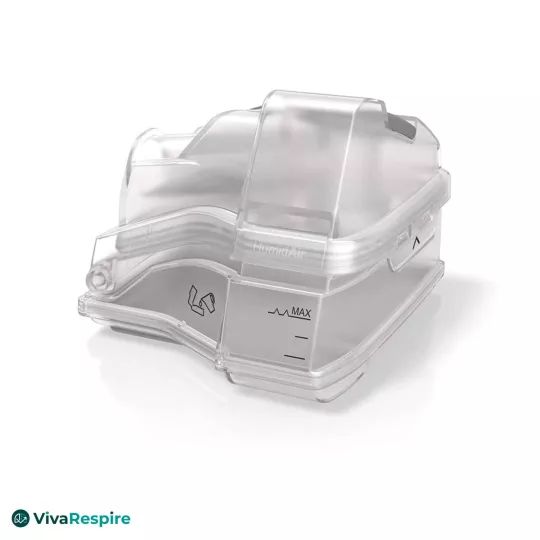
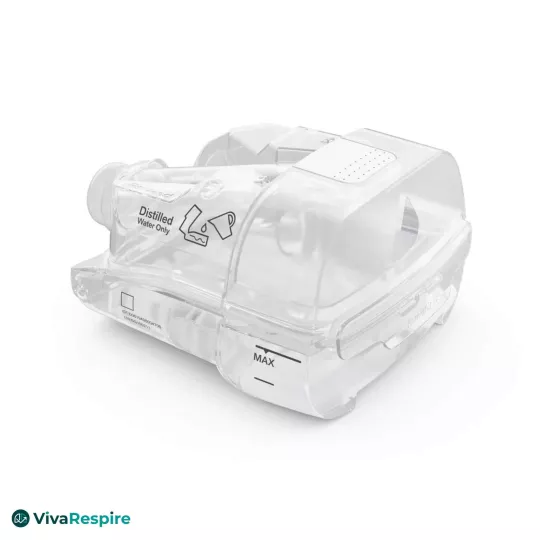
The CPAP humidifier is the accessory that transforms your therapy. Without it, pressurized air dries the nasal mucosa and causes morning dryness, sore throat, nosebleeds and congestion. With it, therapy becomes comfortable, almost imperceptible.
Most modern CPAPs (ResMed AirSense 10/11, Philips DreamStation, Löwenstein prisma) integrate a humidifier in the housing or as a clip-on accessory. The water chamber is filled each evening, the device heats the water and humidifies the delivered air.
Important: HumidAir 10 and 11 chambers are not interchangeable. Check your model before ordering.
On AirSense 10/11, humidity is adjustable from 1 to 8 (or Auto). Practical method:
ResMed and most manufacturers recommend distilled or demineralized water. Tap water contains limescale and minerals that deposit in the chamber, cloud it and shorten its life. Distilled water is found in supermarkets (ironing aisle) at €1-2/liter. One liter lasts about 1 week.
Avoid: scented water, essential oils, boiled water. Any non-distilled additive will damage the chamber and device, and be inhaled.
HumidAir chambers are ResMed-specific. For Philips, Löwenstein, Sefam and Fisher & Paykel, brand-specific chambers are available or being added to the VivaRespire catalog.
Not mandatory but strongly recommended. 70% of patients have dryness symptoms without one (dry nose, sore throat, nosebleeds). With it, comfort improves significantly, and so does therapy adherence. In winter and dry climates, it's almost mandatory. All modern ResMed AirSense CPAPs include it as standard.
No. Chambers were completely redesigned between generations 10 and 11. Clip, seal and dimensions differ. For AirSense 10/AirCurve 10, get the HumidAir II Cleanable. For AirSense 11, get the HumidAir 11 Cleanable.
Only distilled or demineralized water. Tap water contains limescale that deposits, clouds the chamber and can damage the heating system. Distilled water is in supermarkets (ironing aisle) at €1-2/liter. Avoid scented waters, essential oils or other additives: they will be inhaled.
This is rainout: humid air condenses passing through the cool hose in the bedroom. Solutions: (1) lower humidification one level, (2) raise bedroom temperature, (3) cover the hose with an insulating sleeve, (4) switch to ClimateLineAir heated hose which keeps air at temperature to the mask. Option 4 is the most effective.
ResMed recommends every 6 months for standard chambers and every 12 months for Cleanable chambers (more durable, disassemblable). In practice, replace when the chamber becomes cloudy, scratched, or seal tightness fails (leak). With distilled water and weekly cleaning, 12 months is easy to reach.
The Standard chamber is disposable, designed for 6 months max, doesn't disassemble (exterior cleaning only). The Cleanable chamber fully disassembles (two clipped halves), is dishwasher safe (top rack), and lasts 12+ months. Cleanable is slightly more expensive but much more economical long-term and more hygienic. VivaRespire only sells Cleanable.
Daily: empty residual water, air-dry. Weekly: disassemble Cleanable, wash with warm soapy water (mild unscented soap), rinse thoroughly, dry. Monthly: soak 30 min in water + white vinegar 1:5 to descale, rinse, dry. Never use bleach, alcohol or abrasive products.
Yes, but empty the chamber before transport (leaks guaranteed otherwise). On planes, humidification is unusable as battery doesn't support thermal load. Many patients travel without humidifier for short stays (1-3 nights) without particular issues. Beyond, get distilled water on site or use the no-humidification mode.