En
En
 Français
 Nederlands
 Deutsch
 Español
 Italiano
New

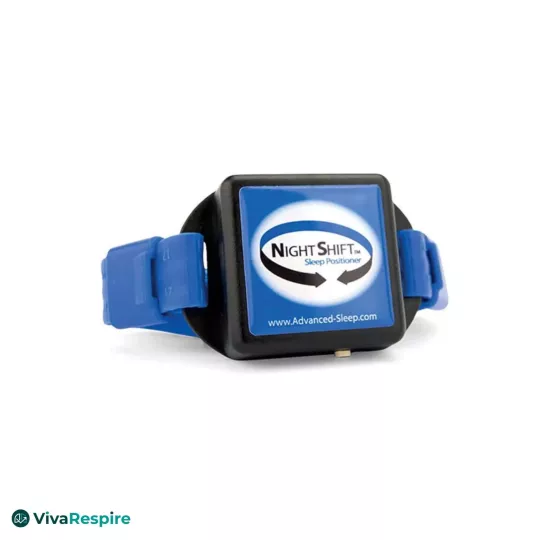
Positional therapy treats positional sleep apnoea: apnoea that happens mainly when you sleep on your back. In a sizeable share of apnoea patients, moving onto the side markedly reduces the apnoeas. The Night Shift Sleep Positioner trains the body to sleep on its side with a gentle vibration.
A complement or an alternative to CPAP depending on severity, and always in agreement with your doctor.
Positional apnoea is a specific form of sleep apnoea. The definition used in clinical practice, known as the Cartwright criterion, is a supine AHI at least twice the AHI in other positions. It is not a rare case: the literature places a positional component in a large share of apnoea patients, depending on the population studied and the threshold used.
For these patients, sleeping on the side or the front markedly reduces the number of apnoeas, sometimes below the pathological threshold of an AHI under 5. It is one of the few forms of sleep apnoea where a change in night-time behaviour can complement, or even replace, CPAP.
Ask your doctor for the supine AHI and the lateral AHI from your last sleep study. That is the key figure for knowing whether positional therapy can work for you.
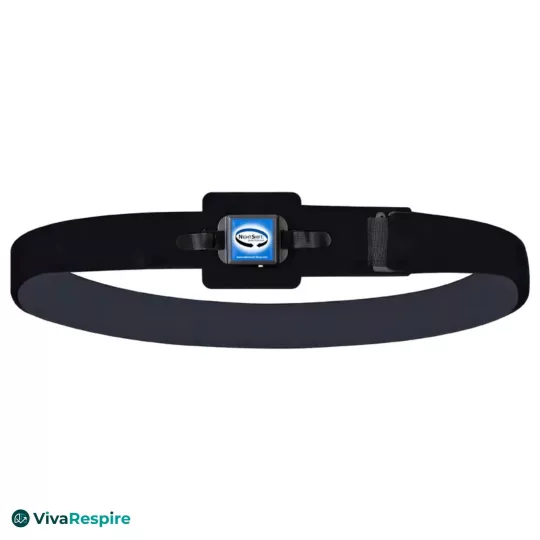
The Night Shift is a compact device worn on the back of the neck, like a soft collar. An accelerometer detects the body's position in real time.
The Night Shift also records night-time data: time spent supine, snoring loudness, sleep quality. A useful follow-up tool to show your doctor.
The figures below come from the study run by Advanced Brain Monitoring, the manufacturer, in patients with positional apnoea. They describe that specific population, not apnoea patients in general:
The device is FDA cleared for the treatment of positional apnoea.
Important: never stop CPAP without medical agreement, even if positional therapy seems to be working. A fresh sleep study while using the Night Shift is the only way to validate stopping.
The Night Shift works alongside:
See also: the complete sleep apnoea guide, snoring and sleep apnoea, CPAP masks for side sleepers.
The criterion used in clinic is simple: your supine AHI is at least twice your AHI in other positions. Ask your doctor for those two figures, they are in the sleep study report. Mild to moderate apnoea, with an overall AHI between 5 and 30, is the most often positional.
Sometimes, and never on your own initiative. In pure positional apnoea, with a high supine AHI and a normal lateral AHI, positional therapy alone may be enough. In mixed or severe apnoea, it does not replace CPAP but can complement it. Either way, the decision is taken with your doctor and checked by a fresh sleep study while using the Night Shift.
The Night Shift is a small device worn on the back of the neck. An accelerometer detects your position. When you roll onto your back, it gives a gentle, progressive vibration meant to trigger the turn back onto the side. Over a few weeks, the body learns to avoid the supine position. The companion app gives the detail of the night: time supine, snoring, sleep quality.
The whole point is not to wake you: the vibration starts very gently and only rises if you stay on your back, so that it acts below the arousal threshold. The manufacturer's study in fact reports less sleep fragmentation on therapy, not more. Some discomfort in the first nights is possible while you adapt. If waking persists, talk to your doctor rather than giving up.
The effect on time spent on the back is immediate, from the first night: that is what the device does directly. The effect on symptoms, tiredness, snoring, daytime energy, takes a few weeks, the time your sleep needs to rebuild. The body gradually learns to avoid the supine position.
Yes. The Night Shift sits on the back of the neck and does not interfere with the mask. The combination makes sense in mixed apnoea: CPAP treats the apnoeas that remain on the side, the Night Shift cuts the time spent on the back. The aim is a CPAP pressure as low as possible, and therefore better comfort. Have the settings validated by your prescriber.
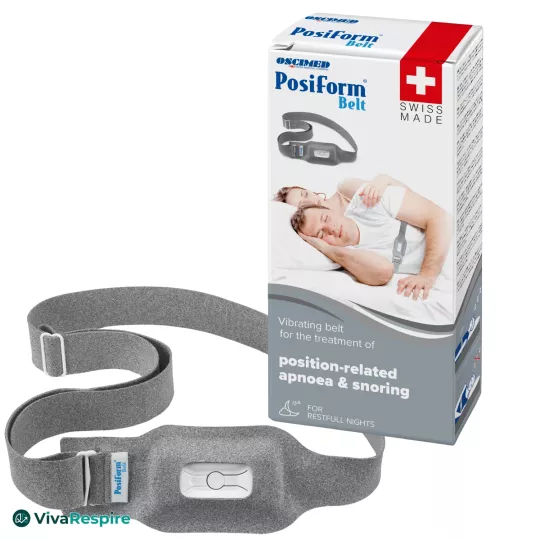
Yes, of two kinds. The simple ones: a tennis ball sewn into the back of the pyjamas, or a positional vest with a foam bumper. They work, but they are bulky and people often abandon them within weeks. The vibrotactile devices: Somnibel, an adhesive sensor worn on the forehead, the Philips NightBalance, an abdominal strap, and the Zzoma, a semi-rigid foam chest belt. The Night Shift is the one that provides the most complete data tracking, and it is FDA cleared for this indication.
In Belgium and France, no: the Night Shift is not covered by INAMI or by the French health system. It is a direct purchase, once, for a rechargeable device that lasts several years. The current price is on the product page. If your apnoea really is positional, it is a one-off outlay to weigh against the cost of a treatment renewed year after year.
What our customers say
Verified reviews from real CPAP patients across Europe.
Recent customer testimonials
J'ai commandé une CPAP Airsense 11. Arrivée rapidement. Tout est nickel.
Très bon site pour le matériel. Et il y a plein d'astuces et d'explications super utiles.
Belle expérience d'achat et j'ai eu réponse à toutes mes questions concernant le produit, prix et le suivi. Je conseille vivement si on veut avoir recours à un vrai professionnel du domaine.