 En
En
 Français
 Nederlands
 Deutsch
-10%
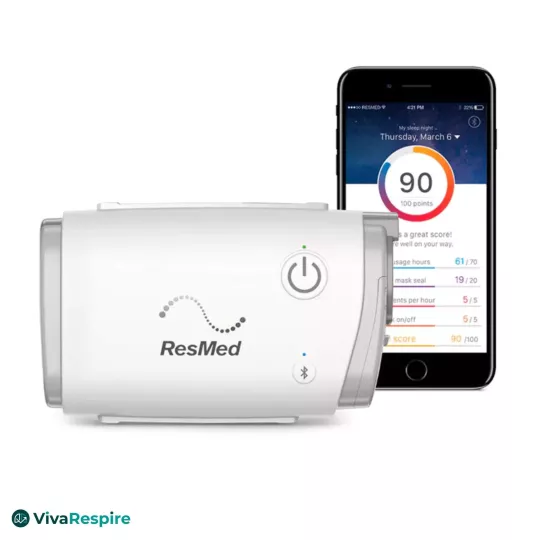

A travel CPAP is an ultra-compact, lightweight machine designed to take your therapy on the road. Small format, battery-compatible, FAA-approved for flying: everything is built to not weigh down your cabin baggage. Ideal for business trips, holidays, camping or as a 2nd CPAP dedicated to travel.
Market reference: the ResMed AirMini AutoSet, the world's smallest auto-adjusting CPAP (~300 g), controlled from your smartphone via the AirMini app. Compatible with the AirFit P10 for AirMini or a dedicated AirFit N20.
Travel CPAPs are miniaturized medical devices that deliver the same therapy as a regular CPAP, in a format designed for mobility. They meet a specific need: not interrupting your sleep apnea treatment when you're traveling.
With a travel CPAP, you maintain your usage hours, your adherence stays good, and you avoid symptom relapse (drowsiness, fatigue) on your return.
The AirMini AutoSet is the absolute reference of the travel segment. Key specs:
A travel CPAP makes sense if you travel several times a year, or if you don't want to carry your home CPAP (bulk, fragility). It's also an excellent 2nd backup device in case of breakdown or aftersales on your main CPAP.
For daily home use, a regular auto-adjusting CPAP is more affordable and offers more complete features (built-in humidifier, touchscreen).
Yes, no problem. CPAP is considered a medical device and generally doesn't count toward your cabin baggage allowance. Prefer FAA-approved models (AirMini, AirSense 11): the mention is in the documentation and eases airport security. Keep the device in cabin, never in hold (impacts + pressurization).
The AirMini is ultra-compact (300 g) and designed for travel: no screen, smartphone control, waterless humidification. The AirSense 11 is the home device (kg+, touchscreen, integrated water humidifier). Same AutoSet algorithm, different format and experience.
Yes, with a compatible external battery. The Medistrom Pilot-24 Lite is the reference for AirMini: it provides a full night of autonomy. Ideal for camping, cruise, night train or as backup during a power outage.
Yes, but without a water tank. The HumidX system is a single-use capsule that sits between the tube and the mask. It humidifies the air using water molecules from your own breath. A HumidX capsule lasts about 1 month of use. Less powerful than a regular water humidifier, but perfectly suited to travel.
No. The AirMini uses a specific tube system (the tube integrates the exhalation valve). You need a ResMed mask compatible with AirMini: AirFit P10 for AirMini, AirFit N20 for AirMini or AirFit F20 for AirMini. These are the standard masks with a dedicated AirMini connector.
Technically yes (the AirMini delivers therapy identical to a home CPAP), but not optimal for daily comfort. Waterless humidification is less powerful in case of dryness, no screen makes control less direct, and the higher cost is not justified if you don't travel. Best: an auto-adjusting CPAP for home + an AirMini for travel.
The AirMini AutoSet is €1,100 at VivaRespire. More expensive than a home CPAP (€520-560) due to miniaturization and embedded tech (algorithm, connectivity, FAA, waterless humidification). One quality travel CPAP is a lasting investment, amortized over several years.
The Belgian INAMI/RIZIV convention generally covers only one device per patient (the main CPAP). A travel CPAP as a second unit is therefore not reimbursed. This is typically where direct purchase at VivaRespire makes sense: you keep your convention CPAP at home and buy the AirMini for travel. To understand, see CPAP reimbursement in Belgium.
What our customers say
Verified reviews from real CPAP patients across Europe.
Recent customer testimonials
J'ai commandé une CPAP Airsense 11. Arrivée rapidement. Tout est nickel.
Très bon site pour le matériel. Et il y a plein d'astuces et d'explications super utiles.
Belle expérience d'achat et j'ai eu réponse à toutes mes questions concernant le produit, prix et le suivi. Je conseille vivement si on veut avoir recours à un vrai professionnel du domaine.