Positional therapy: Night Shift or PosiForm Belt
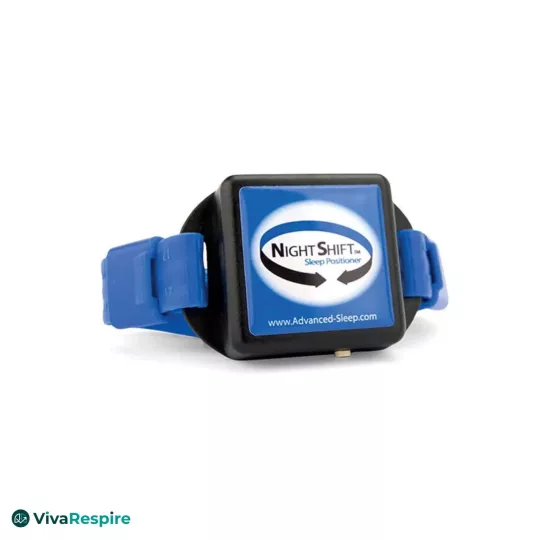
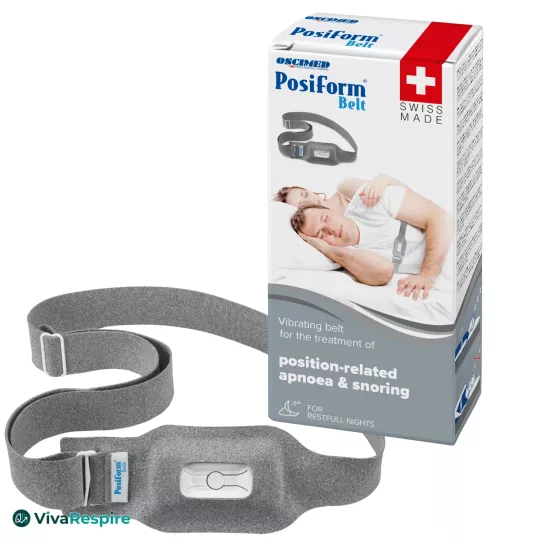
Positional therapy is for people whose apneas or snoring happen mostly on their back. A small device, worn on the neck or the chest, vibrates when you roll onto your back, prompting you to turn onto your side. Here is what is known about it, its limits, and how the two devices we offer compare, based on their official user guides.
Who it is for, and how well it works
In some patients, apneas occur mostly when lying on the back. The position sensor of a polysomnography shows this: it tells back, front and sides apart. In a Cochrane review (Srijithesh, 2019), positional therapy reduced the AHI by about 7 events per hour compared with no treatment, less than CPAP, but patients were more willing to use it. The studies were short: its long-term effect is not well known.
Night Shift or PosiForm Belt
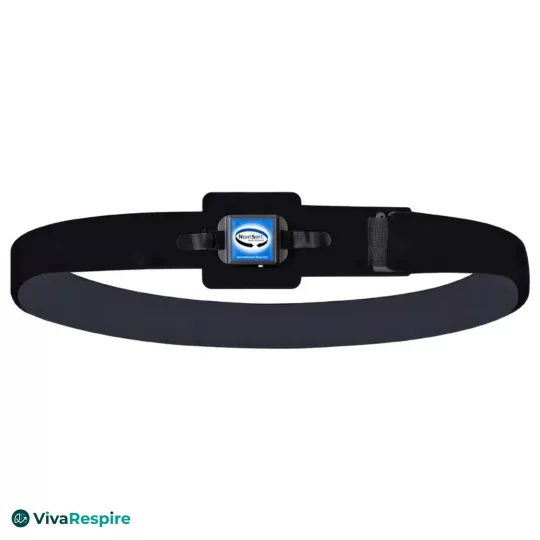
| Night Shift | PosiForm Belt | |
|---|---|---|
| Where it is worn | On the neck (strap) or the chest (chest belt) | On the chest, in an adjustable belt from 70 to 125 cm |
| When it vibrates | On your back, once the first 15 minutes after switching on have passed | About 10 to 15 seconds after you roll onto your back, until you turn over |
| Power | Rechargeable battery (indicator up to 3 nights, charging in 3 h at most) | 2 AAA alkaline batteries, at least 2 months if the belt vibrates no more than one hour per night |
| Recording | Yes: position, movement and sound, with reports in the Night Shift Therapy app or the Report Portal software | No |
| Settings | Through the Night Shift app or software | Vibration intensity adjustable on the device, with the button |
| Do not use | Pacemaker for arrhythmia, sensitive skin or an open neck wound, neck under 30 cm or over 55 cm, sleeping near-upright, head tics or tremors | Pacemaker (strictly forbidden) |
| Care | Replace the strap or belt every six months | Change the batteries; the unit is not protected against water |
According to its user guide, the Night Shift is intended, on prescription, for adults with positional obstructive sleep apnea with a non-supine AHI below 20, and for snoring. The PosiForm Belt targets snoring and apnea linked to sleeping on the back.
- The Night Shift if you want to measure: it records your positions and snoring, so you can see whether the therapy works and discuss it with your doctor. It can also be worn on the neck, for those who cannot bear a belt.
- The PosiForm Belt if you want the simplest option: a belt, two batteries, no app and no charging.
The first nights
The PosiForm Belt user guide plans an adjustment period of one to two weeks: the vibrations may disturb your sleep at first. Tighten the belt so it stays in close contact with your body, otherwise stronger, noisier vibrations are needed. The Night Shift waits 15 minutes before vibrating, giving you time to fall asleep. Possible effects, according to the PosiForm Belt user guide: disturbed sleep, back pain. If they persist, stop and ask your doctor.
To find out whether it works: your partner can tell you whether you sleep on your side and still snore. In the case of apnea, only a medical check confirms that it works. Snoring on its own can also be a sign of apnea: see snoring and sleep apnea.
Our devices and spare parts are in the positional therapy category.